Marketing Hub
Consolidated three fragmented marketing tools into one platform inside TikTok's Ads Manager — saving $336K annually and lifting qualified leads 40%.
Role
Product design lead
Team
1 PM, 2 Software Engineers
Timeline
Two quarters to global launch
Focus
UX Strategy, Information Architecture, UI Design, Prototyping, Vision
Impact
$336K
Annual tool spend removed
75%
Increase in MQL's
50
Weekly active users
100%
Events logged in platform
The problem
Global Business Marketing ran its entire motion outside TikTok's internal CRM. Audiences were built by exporting advertiser lists out of our own platform and re-uploading them into HubSpot to apply targeting. Email campaigns lived in HubSpot too. Events ran on Splash. When a marketer identified a qualified lead, it reached Sales through Lark sheets and Lark channels.
Each tool did its job — the seams between them were the problem. The moment a list left the platform, it stopped being connected to anything we knew about that advertiser, and everything downstream had to be reconstructed by hand.
Current state
Everything downstream, who engaged, who converted, what it was worth all lived on external tools

The foucs
Bring these three core functionalities into the CRM platform to close the loop on the end-to-end sales and marketing journey

The reframe
Three targets, one real problem, and the shift that unlocked every decision after it.
The mandate
Cut spend on external tools. Keep advertiser data in-house. Generate more MQLs. All three are real, and all three are reasons to start.
The real problem
GBM's stack was structurally blind to TikTok's own data, and the final handoff to Sales was a spreadsheet.
The reframe
Consolidation was the mechanism. Closing the loop was the goal, and that's what let every scope decision after it get made.
Research: finding where the variance actually lived
28 marketers, four regions
Interviewed across NA, EU, APAC, and LATAM, roughly seven per region.
What was consistent
Passive exposure isn’t education. Learning had to be structured and testable.
What actually diverged
Almost entirely after a lead existed — qualification, routing, tagging, conversion — and no standardized process between Marketing and Sales at all.
The modal

The audience layer became one product

Audience is the shared object. Emails and Events both consume it, so everything built after it compounded instead of stacking.
The lead layer became configurations, not forks

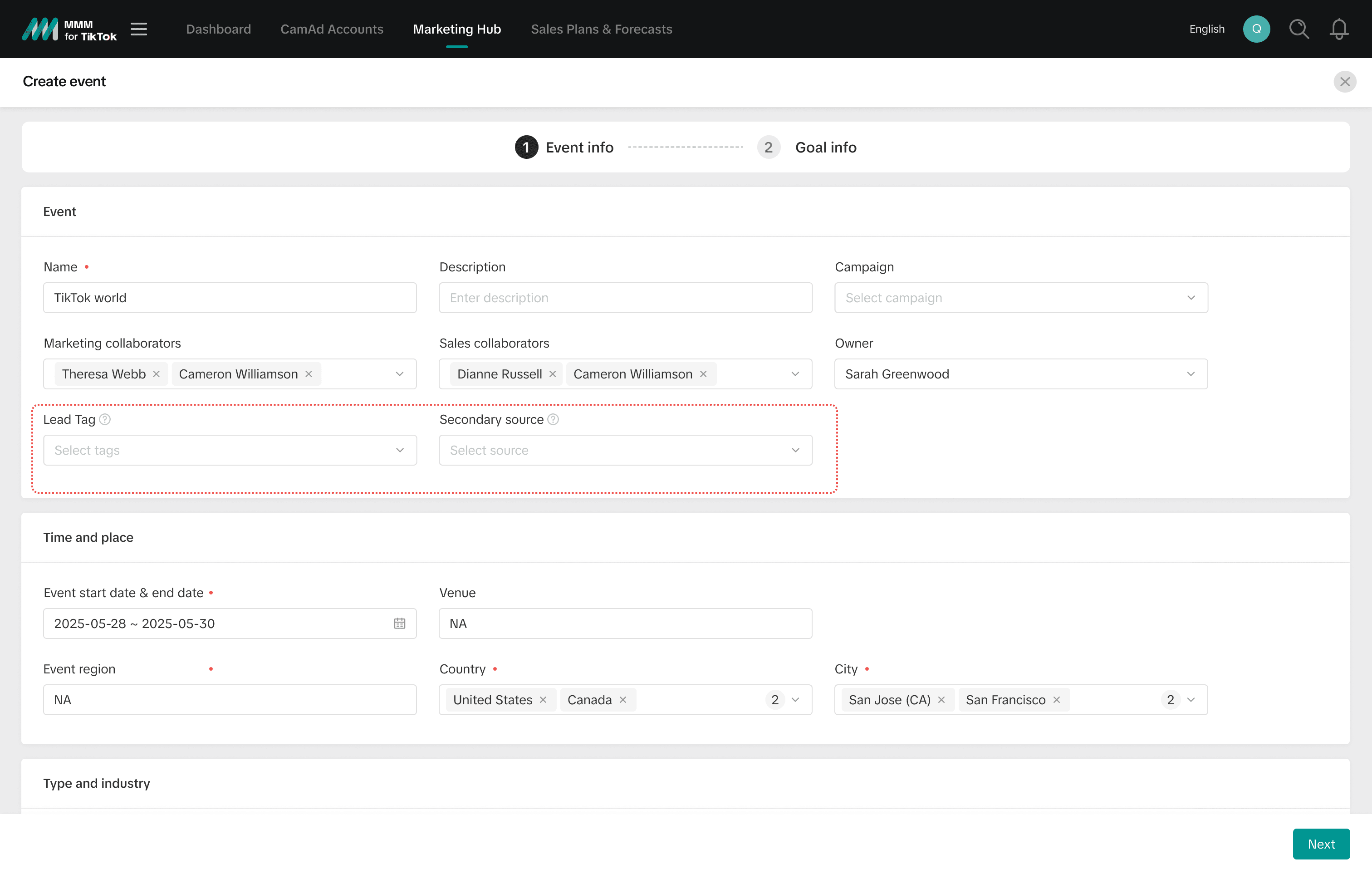

Instead of four regional variants, one surface with the knobs regional teams actually needed: direct upload, auto-identification from events and emails, tags that route leads to the right teams, and assignment on-platform instead of in a spreadsheet. This is what made a two-quarter timeline possible with one designer and two engineers — the object model did the work, not sheer velocity.
Designing past the brief: Sales inside the loop
Marketing notifying sales for review.
Before invitations go out, Sales reviews the invitee list and can approve, remove, or assign an account to a wave. Once Marketing finalizes the list, it locks and no further edits can be made.
This isn't about efficiency. Sales owns the advertiser relationship, and an invitation to an account that's mid-negotiation or already committed elsewhere isn't a wasted send; it's a relationship risk. Building the check into the product means Marketing never has to know account state, and Sales never has to police lists after the fact. The lock is the accountability mechanism the old process never had: once the list is final, both orgs are committed to the same artifact, which a Lark thread could never enforce.
When teams refused to move to Splash
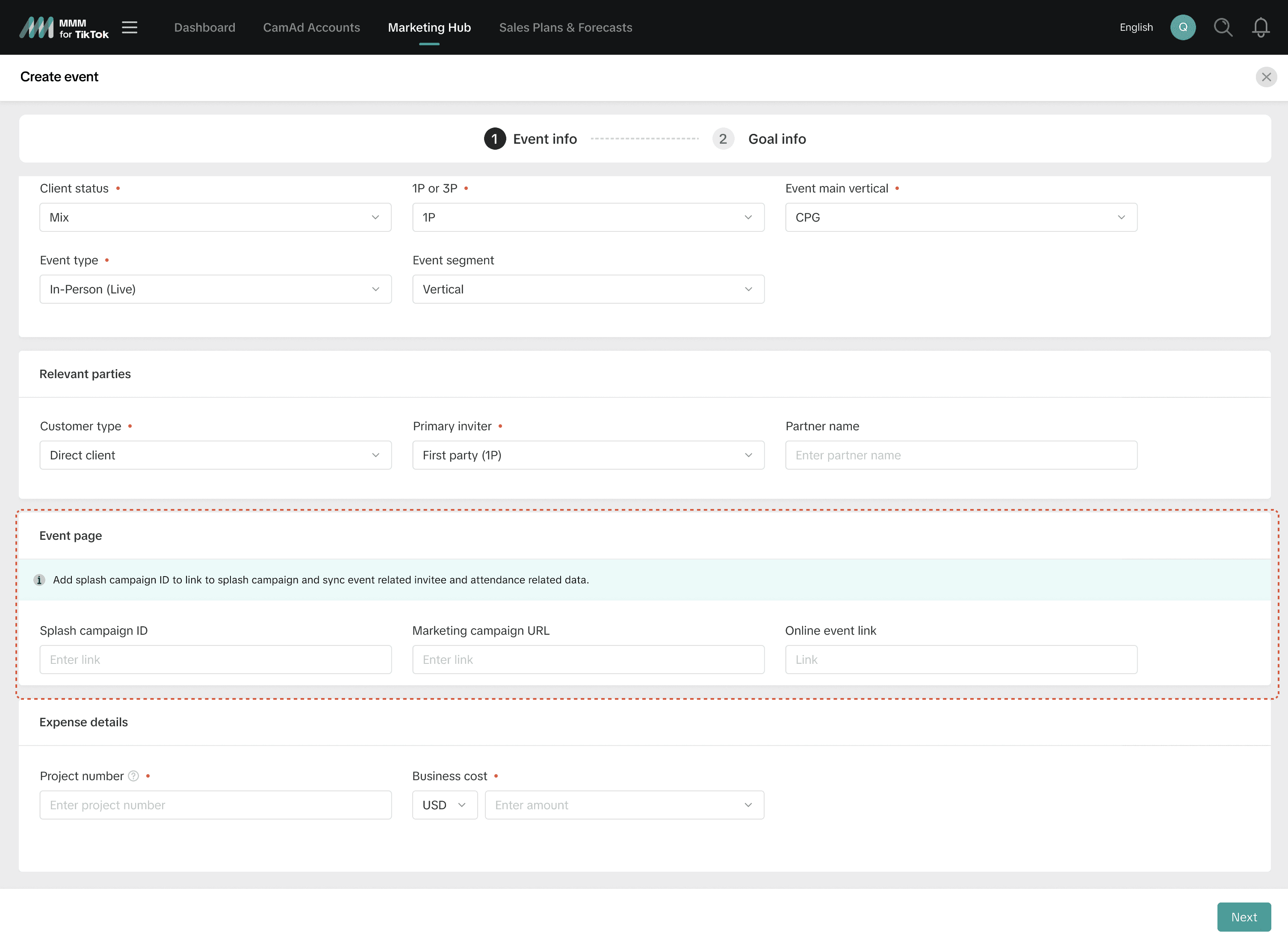
Adoption was mandated top-down, but a mandate only holds if the product does the job, and on Events, it didn't at first. Several teams pushed back on leaving Splash because the MVP didn't cover their use cases.
Rather than force migration on an MVP that wasn't ready, or chase Splash parity the team couldn't staff, we synced data by including Splash links, so events still running externally kept feeding attendance and leads back into Marketing Hub. Migration became gradual instead of a cliff, and the loop stayed intact either way.
Outcome
$336K
Annual tool spend removed
40%
Increase in MQL's
~20K
MQLs generated per quarter
50
Weekly active users
100%
Events logged in platform
4
Regions live (NA,EU, APAC, LATAM)
The vision
Phase 1: Workflow builder
Regional teams configure forms whose answers trigger automated actions: routing, assignment, and email sends, without needing an engineer for every new rule.
Phase 2: AI chat experience
I chat experience where marketers describe an audience in plain language, and the platform builds the segment for them, instead of manually configuring filters.
Reflection
The strongest decision in this project was made in research, not in Figma. And the feature I'd point to first, Sales invitee review, wasn't in the brief. It was in the gap between two orgs that no tool in the old stack was positioned to see.
Learn more
There's so much more behind the scene! Reach out to see additional design explorations.