
Micro Learnings
Cut advertiser strike volume 66% - from policy violation to behavior change.
Role
Product design lead
Team
1 PM, 2 Software Engineers, Content Designer, Localization Team
Timeline
~7 weeks
Focus
UX Strategy, Information Architecture, UI Design, Prototyping, Vision
Impact
-66%
Strike volume per advertiser
75%
Module completion rate
4.7
CSAT, +14% vs. platform
69%
Quiz pass rate, first attempt
The problem
An advertiser builds their first TikTok ad, launches it, and it gets suspended - no clear reason, no warning, just a link to a long policy page and no way forward. Thousands of advertisers hit this same wall every day.
Every suspension is lost revenue. Bad ads still slip through when advertisers don’t understand what they did wrong. And the old system had no way to tell whether any of it was working.
Advertiser lifecycle
This problem does not start at violation, it starts the moment an advertiser creates their first ad

The foucs

The reframe: it starts at creation, not violation
Every ad follows the same lifecycle — creation, review, and, if something’s wrong, violation, education, resubmission. Most systems treat the violation as the end of the story. I treated it as the highest-leverage moment to intervene.
Intent is clear
Advertisers who delete a violating ad and contact support are already signaling they want to comply.
Pain is highest
Lost revenue and a confusing rejection mean motivation to learn is never stronger than right after a violation.
Behavior actually changes here
The violation creates urgency — that’s when new information sticks.
What research told us
Good-intent advertisers show remorse through action - they delete violating ads and contact support themselves.
They don’t need punishment, they need a clear path back.
Existing materials were long, text-heavy, and not actionable: TikTok Academy and the Help Center weren’t built to be learned from.
Passive exposure isn’t education. Learning had to be structured and testable.
There was no reward for completing corrective action — no strike reversal, no account health improvement, no reason to follow through.
The reward mechanic isn’t a nice-to-have. It’s the entire behavior - change engine.
Deciding the structure
I explored three directions with the Learning Design team: flashcards, a contextual (if/then) format, and a sectioned layout - weighing each on user clarity, engineering effort, and long-term scalability. The sectioned layout won: it scored highest on scalability and localization, and in testing, 7 of 8 participants found it easier to scan than the alternatives.
One structural detail mattered more than expected: video placement. Leading with video caused people to skip the text entirely; placing it after the policy overview got full engagement on both the video and the surrounding text.
Deciding the quiz format
I tested showing all quiz questions at once against one question per page. One at a time won decisively, 92% average comprehension versus 76%, with participants spending 23% more time per question and giving noticeably more thoughtful answers. A visible progress indicator kept people from abandoning the quiz partway through.
Designing inside real constraints
The module couldn’t open natively inside Ads Manager, it loaded as a sandboxed iframe with no access to platform navigation, tracking, or live account data. Every wayfinding element, progress, navigation, completion state had to be built from scratch inside the module itself.
Separately, the original do/don’t cues relied on color alone, which failed for color-blind users. I replaced them with iconography so the distinction didn’t depend on color at all.
Getting learning to the right moment

The original plan had no presence inside Ads Manager at all, advertisers would have found this through email, a channel with no completion tracking and an easy thing to miss. I partnered with the Dashboard team to surface the module inside Account Health, right where advertisers already were the moment a violation hit.
From there, content was personalized by advertiser lifecycle stage: new advertisers get policy fundamentals, established advertisers get depth specific to their own violation history.
A new entry point

The insight started small: critical policy updates and learning materials were being shared over email, a channel advertisers routinely missed or found hard to revisit. Bringing learning into the advertiser's existing workflow, instead of adding another channel to check, is what made an in-platform entry point non-negotiable.
Designed for global reach

Localization-ready layouts adapt to different languages and regions while preserving clarity, hierarchy, and usability across devices.
Learn Anywhere, Anytime
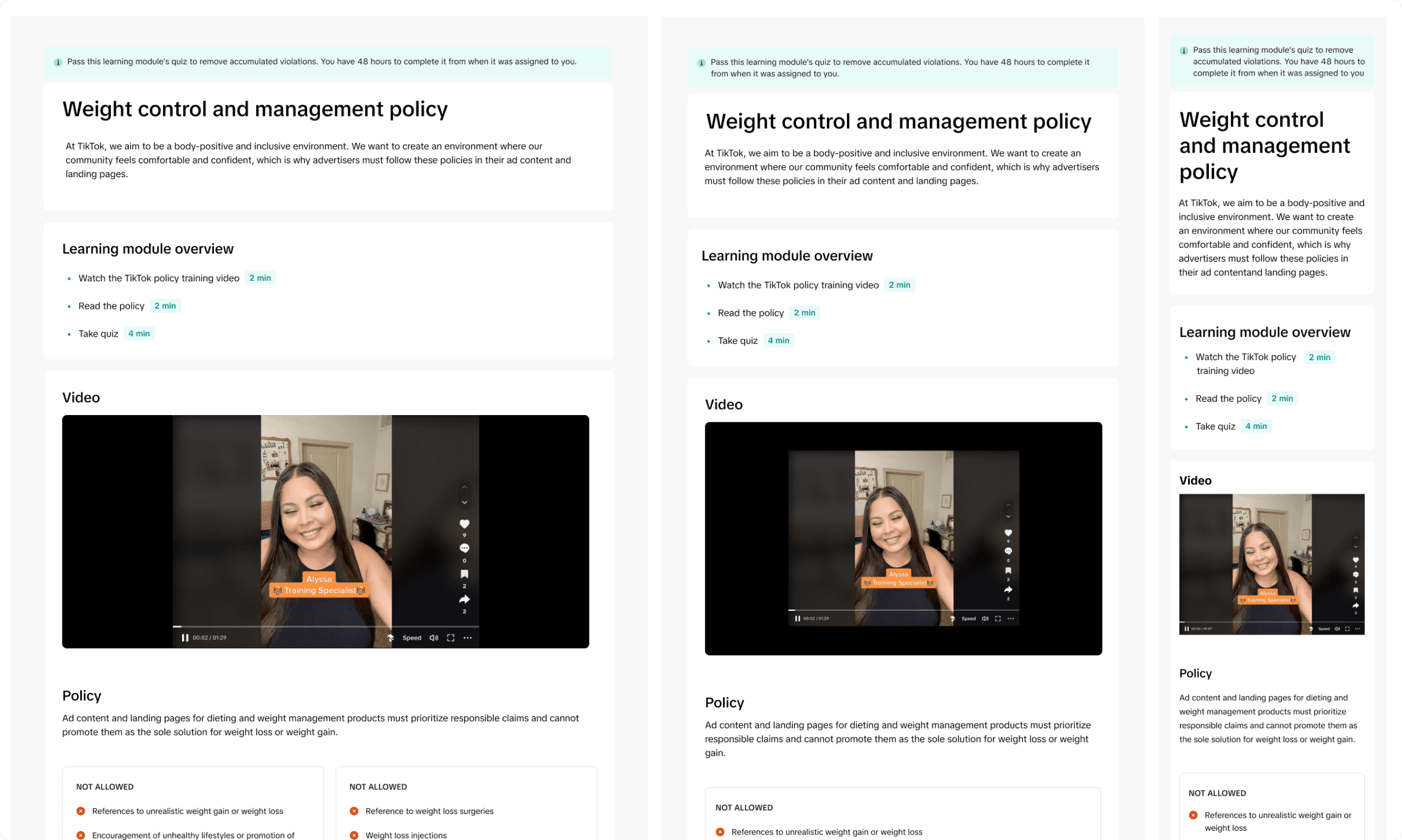
Responsive design ensures the microlearning experience is accessible across all devices, allowing users to engage with training content anytime.
Outcome
-66%
Strike volume per advertiser
75%
Completion rate, ~8 min avg
69%
Quiz pass rate, first attempt
4.7
CSAT, +14% vs. platform
-7%
Overall ad rejection rate
~3%
Increase in active ad revenue
The number that mattered most wasn’t completion - it was the drop in strike volume. That’s the loop actually closing: design → learning → behavior change → platform integrity.
The vision
Phase 1: Pre-approved ads
Advertisers upload creatives in advance for automated policy checks, with real-time feedback so they can fix issues before submitting - fewer rejections, faster approvals, fewer appeals.

How it works
AI moderation scans content for potential violations
Real-time feedback highlights issues
Advertisers make proactive edits before submission
Impact
AI moderation scans content for potential violations
Real-time feedback highlights issues
Advertisers make proactive edits before submission
Phase 2: AI-powered ad builder
An AI tool that generates compliant video ads directly, with policy guardrails built into footage, copy, and music selection - compliance built into creation, not checked after the fact.

How it works
Cut footage based on policy requirements
Suggest compliant ad copy and built-in policy guardrails
Add voiceovers and select appropriate music
Impact
Compliance built into creation, not checked after
Democratized ad creation
Near-zero policy violations
Reflection
The old system gave advertisers information and hoped they’d change. The quiz only worked because passing it actually did something - violations removed, access restored. The design decision and the product strategy were the same decision.
Learn more
There's so much more behind the scene! Reach out to see additional design explorations.


